


The ATI Radeon 5870 is their follow-up to the 4870 and the current single-GPU flagship of the new 5000-series. The 5870 offers a number of improvements over the 4870 in terms of performance, power consumption and features. The most notable new feature is the new "ATI Eyefinity Multi-Display Technology" (Eyefinity), which offers multi-monitor gaming (similar to Surround Gaming from Matrox) on a single graphics card. This review of the 5870 will focus on the Eyefinity feature, and how issues affect Eyefinity users.
From a specification perspective, the 5870 is a clear departure from the 4870. It moves to a 40nm fabrication process, which helps lower power consumption. While at full load power, consumption on the 5870 is only slightly higher than the 4870, but the idle is extremely low. The 5870 is a huge increase in both transistors and shaders, though the increases in clock speeds are more modest.
Below is a comparison of the 5870 and it's counterparts from the Radeon 4000-series and the NVIDIA GeForce 200-series.
| Card | Fab | Transistors | Max Memory | Shaders | Clock (MHz) | TDP (Watts) | ||
| Core | Mem | Idle | Max | |||||
| ATI Radeon HD 5870 | 40nm | 2.15B | 1GB | 1600 | 850 | 1200 | 27 | 188 |
| ATI Radeon HD 4870 x2 | 55nm | 2x 956M | 2x 1GB | 2x 800 | 750 | 900 | 286 | |
| ATI Radeon HD 4870 | 55nm | 959M | 2GB | 800 | 750 | 900 | 90 | 160 |
| NVIDIA GeForce GTX 295 | 55nm | 2x 1.4B | 2x 896MB | 2x 240 | 576 | 2322 | 289 | |
| NVIDIA GeForce GTX 285 | 55nm | 1.4B | 2GB | 240 | 648 | 1998 | 183 | |
As you read through the review, you will see that I point out a number of things that I think have room for improvement. The majority of these issues are minor, and are simply annoyances. It may seem like I do not like the Radeon 5870 or the Eyefinity technology. This is not the case.
The Radeon 5870 is a great card for single for multi-monitor gaming, and the Eyefinity technology is a huge leap forward in bringing multi-monitor gaming to the mainstream. I point out these issues to share my experience and opinion, and to hopefully have some of these issues addressed. The Eyefinity experience is great with the Radeon 5870, I'd simply like to see it be even better.
Eyefinity
Eyefinity is ATI's entry into the multi-monitor gaming space originally created by Matrox with the Parhelia, and popularized with the TripleHead2Go. Eyefinity is a major step forward for mainstreaming and removing barriers to multi-monitor gaming.
The Eyefinity Experience
The release of the Radeon 5870 offers a multi-monitor experience similar to the TripleHead2Go, in that it allows for a 3x1 configuration. Eyefinity allows for both landscape and portrait configurations, but the most common implementation is landscape. To see how this looks in action, check out the TH2Go videos in our YouTube Channel. The Radeon 5870 is largely aimed at the mainstream market, and simply brings with it the introduction of Eyefinity.
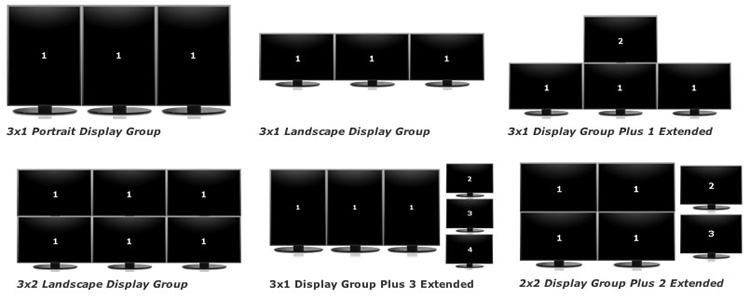
The upcoming Eyefinity6 card will allow for six active monitor connections and have 2GB of VRAM. It will be aimed squarely at the multi-monitor enthusiast. The graphic below showcases some of the major configuration options. The first two are available with the 5870, and the last four will be available with the Eyefinity6.
Differences from the TripleHead2Go
ATI's entry into this space forgoes the need for the "break-out" box or "middleware" of the TripleHead2Go (TH2Go). It also avoids the need to be reliant on the proper interaction of the Matrox GXM and the graphics card driver, to achieve the panoramic views of multi-monitor gaming. The ability to forgo this extra piece of hardware and custom software solution helps to bring multi-monitor gaming closer to the mainstream.
The Eyefinity solution solves a number of key issues that were inherent in the Matrox TripleHead2Go. First, users are no longer bound to 1680x1050 being the max resolution supported on each monitor, and users are no longer limited to 57Hz at 5040x1050. The ability to use larger panels at their native resolution helps to improve the immersive experience.


